
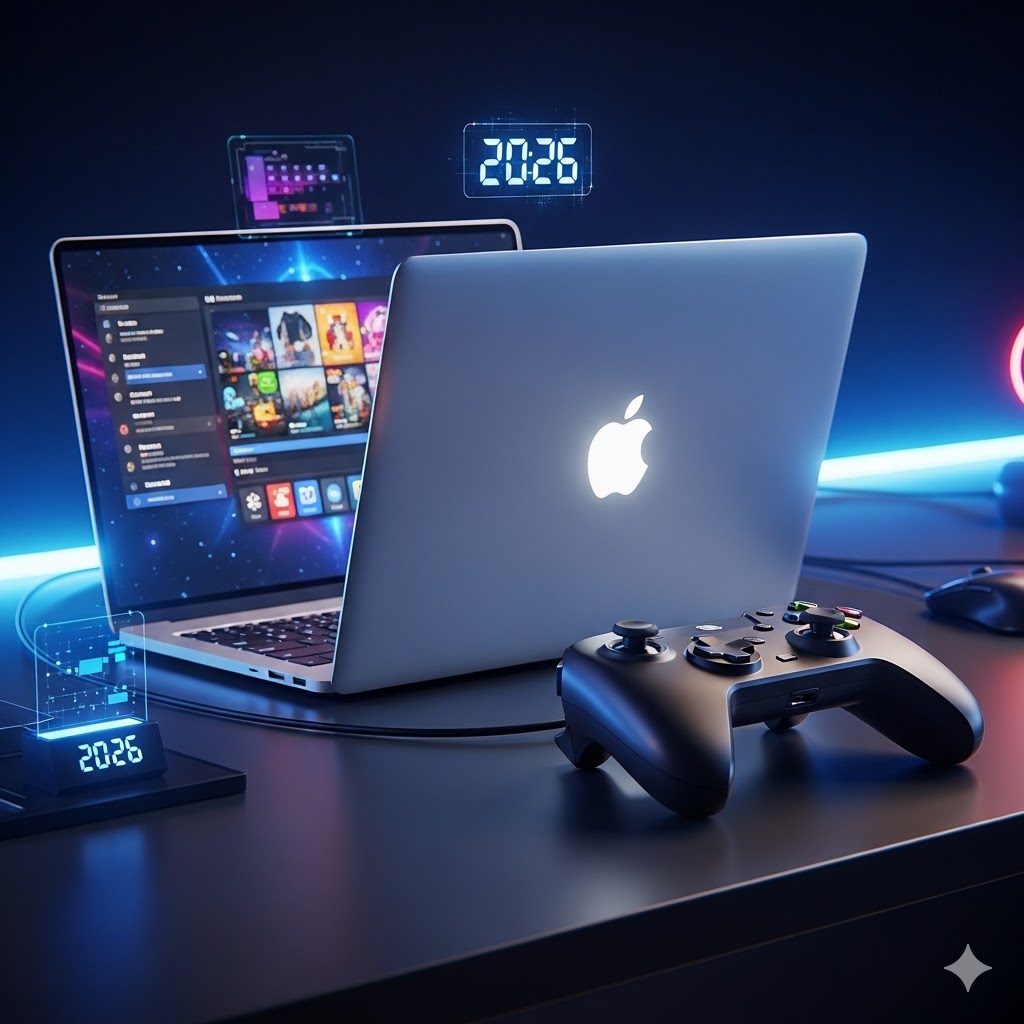
Apple and Gaming in 2026: Capable Isn’t the Same as Committed
At this point, nobody serious is questioning Apple’s hardware. The M-series chips are genuinely impressive, and anyone who’s watched a AAA title run on Apple Silicon knows the silicon argument is basically settled. So let’s move on to the more interesting question: does Apple actually want a real gaming ecosystem, or does it just want gaming as a bullet point in a keynote?
Because those are very different things.
Real gaming platforms are built on consistency. Developers know what to expect year after year. Release cycles are predictable, tooling is stable, and the platform shows up for major launches without anyone having to beg. When a big title drops, platform support is an assumption, rather than a negotiation.
Apple’s history with gaming has been… episodic. A flashy demo on stage. A new API push. Some developer outreach. Then relative quiet while PC and console ecosystems keep grinding forward at full speed. That pattern created a deep well of skepticism among developers and players alike, and skepticism doesn’t evaporate just because the hardware got better. Trust is rebuilt through behaviour, not benchmarks. The pattern is certainly there, if one looks slightly closer. But there’s more to it…
There’s another force at play here that doesn’t get talked about enough in the Mac gaming conversation: “Windows is actively pushing people away.“
This isn’t just the usual “Windows vs Mac” tribalism. Something has shifted in the last couple of years. Microsoft’s aggressive and often clumsy push to bake AI into every corner of Windows, features that nobody asked for, running in the background, eating resources, occasionally doing genuinely unsettling things like screenshotting your entire session, has eroded a lot of goodwill. Nobody asked for this. Copilot integration that feels bolted on. Ads in the Start menu. Bloat that accumulates faster than any update can clean it up. The overall experience has become inconsistent in a way that’s hard to forgive on a platform that’s supposed to be the serious productivity and gaming workhorse.
Meanwhile, MacBooks have become genuinely hard to argue against for daily use. Silent operation. Battery life that lasts a full workday without anxiety. Performance that doesn’t throttle the moment you unplug. A consistent, predictable experience across the entire lineup. People who switched and expected to miss Windows often find that, for everything except gaming, they don’t miss it at all. The only use my Windows desktop, a beast in specs, has for me is gaming. For everything else, it’s my MacBook.
And that’s exactly the problem Apple needs to solve because that’s where the opportunity is sitting, wide open.
There’s a very real and growing segment of people who are essentially running a two-device or dual-boot life out of necessity. Mac for everything: work, browsing, creative work, communication. Windows for one thing: gaming. That’s it. The entire reason Windows still has a foothold in their life is a Steam library and the knowledge that the games they want to play will just work. If macOS closes that gap meaningfully, those people aren’t switching back. There’s nothing to go back to, Microsoft burned that bridge itself.
This is a genuinely unusual position for Apple to be in. Historically, Mac gaming advocacy was about convincing people to consider the Mac as an alternative. Now, for a growing number of people, the Mac is already the primary machine. They’re not weighing a switch, they’ve already switched. They just need gaming to follow them. Just do a YouTube search of “Switch to Mac from Windows” and you’ll know what I’m talking about. This is indeed, a silent revolution no one is really talking about.
That changes the nature of the ask. Apple isn’t trying to win over Windows loyalists anymore. It’s trying to complete the transition for people who are already halfway there and increasingly frustrated that the last thread keeping them on Windows is a platform problem Apple has the power to fix.
The most important question right now is whether Apple has created genuine economic clarity for developers. Studios put resources where returns are predictable. Supporting an additional platform means real engineering hours, QA cycles, and ongoing maintenance costs. If macOS is treated as an afterthought by the market, developers will treat it the same way, and they won’t feel bad about it.
Apple has done real work on tooling and friction reduction, credit where it’s due. But seriousness isn’t measured in a single release cycle. It’s measured over several. When developers ship simultaneously on macOS and Windows without anyone making a big deal of it, that’s normalization. When ports arrive six months later with a quiet blog post, that’s still hesitation dressed up as progress.
But viable isn’t the same as essential, and Apple doesn’t need to dominate gaming. What it needs is credibility within the ecosystem.
The cadence is better than it was. It’s still not quite right.
There are genuinely encouraging signs though. More native releases are showing up. Indie developers are increasingly treating macOS as part of their baseline distribution plan rather than a stretch goal they’ll “get to eventually.” The conversation has shifted from “you can’t game on a Mac” to “actually, you can” – and that shift didn’t happen by accident.
But viable isn’t the same as essential, and Apple doesn’t need to dominate gaming. What it needs is credibility within the ecosystem.
Platform predictability is another dimension worth taking seriously. Developers building for Windows or consoles understand the long-term architecture. Roadmaps are reasonably clear. Backward compatibility is a known quantity. Apple, by contrast, has shown it will pivot hard and fast when it serves a broader strategic goal. The Intel-to-Apple Silicon transition was technically brilliant and also sent a clear message to studios maintaining legacy codebases: we’ll move when we’re ready, Rosetta will soften it, good luck.
For a lot of developers, that decisiveness is admirable in the abstract and nerve-wracking in practice. Serious gaming platforms work to reduce that kind of long-term risk calculation, not add to it.
The unified architecture strategy adds another wrinkle. In theory, shared foundations across iPhone, iPad, and Mac should simplify development. In practice, the performance envelopes and input expectations across those devices are different enough that you can’t just treat them as identical deployments. A game designed for touch doesn’t automatically translate into a desktop gaming experience worth having. If Apple wants macOS to be taken seriously as a gaming platform, convergence can’t come at the expense of each device’s identity.
Apple’s approach feels like showing up to a party, doing one impressive trick, and then leaving before anyone can ask follow-up questions.
Then there’s the messaging problem and honestly, this is where Apple is most visibly dropping the ball.
Apple doesn’t really talk to gamers. When gaming shows up in presentations, it’s framed as a demonstration of what the chip can do, not as a cultural statement or a competitive move. Compare that to platforms where gaming is central to brand identity: companies that sponsor events, cultivate communities, and maintain ongoing dialogue with both players and studios. Apple’s approach feels like showing up to a party, doing one impressive trick, and then leaving before anyone can ask follow-up questions.
Apple’s strengths are integration and polish. Gaming culture is messier than that. It runs on modding, competitive scenes, rapid patch cycles, and the kind of chaotic community-driven momentum that doesn’t really fit inside a polished product announcement. Whether Apple is genuinely comfortable operating in that mode at scale is still an open question.
Apple Arcade is worth mentioning here, though it’s a bit of a double-edged sword. On one hand, it shows Apple sees gaming as strategically meaningful. On the other, it’s focused on curated, often mobile-adjacent experiences, not the competitive or AAA ecosystem that PC gamers actually care about. Arcade is great for Apple’s services numbers. It doesn’t do much for the player who wants day-one parity with a Windows release.
Seriousness, in practical terms, means committing to parity.
When macOS appears alongside Windows at launch without asterisks or caveats, that’s confidence from both Apple and the studios shipping on it. When major engines treat macOS as standard rather than experimental, that’s normalisation. When driver updates, documentation, and developer support improve quietly but consistently over years rather than in splashy cycles, that’s maturity.
In 2026, Apple looks more deliberate about gaming than it did five years ago. The tone feels less like experimentation and more like infrastructure, and that’s a meaningful shift.
The signals are moving in the right direction. They’re just not automatic yet.
It’s also worth being honest about Apple’s incentives here. The company doesn’t need gaming revenue the way console manufacturers do. Hardware margins, services, and ecosystem lock-in are what drive Apple’s business. Gaming makes the hardware more appealing, but it’s not existential, and that reality shapes how much urgency actually exists behind closed doors.
When something isn’t existential for Apple, it needs to be strategically justified on an ongoing basis. Apple clearly recognises that gaming strengthens the case for its silicon and adds coherence across devices. Whether that recognition holds up over multiple years of sustained investment, or fades when a shinier priority emerges, is still the open variable.
In 2026, Apple looks more deliberate about gaming than it did five years ago. The tone feels less like experimentation and more like infrastructure, and that’s a meaningful shift. But the final verdict isn’t written yet. A serious gaming platform isn’t announced. It’s built through repetition – the unglamorous, cycle-after-cycle work of maintaining compatibility, supporting developers, and showing up consistently enough that nobody has to wonder if you’re still paying attention.
The next few years will tell us whether gaming is a permanent pillar of the Mac experience or just a recurring showcase for whatever chip Apple is most proud of that year.
The industry is watching. And it has a long memory.
