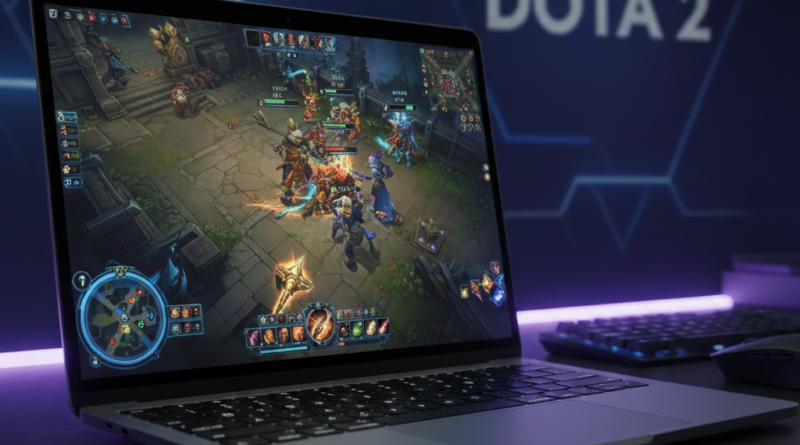
Dota 2 on macOS is Still the Best Native Game – And It’s Free
There are technically more demanding games available on macOS today. There are titles with better lighting, heavier assets, and more cinematic appeal. But if the goal is to understand what native gaming on Apple Silicon actually feels like when the engine, API, and hardware are aligned, the conversation still begins with Dota 2.
Dota 2 is not new. It is not designed to show off the latest graphics features. What it does offer is something far more useful: a stable, competitive, real-world workload that exposes weaknesses quickly. Plus the game is incredibly popular, regularly topping the charts of highest concurrent users. Ranked matches are chaotic by design. Five ultimates stacked in one choke point, particle effects layered across the screen, camera movement, rapid input changes, and network traffic all happening simultaneously. If a Mac is going to struggle, it struggles here.
After testing across multiple Apple Silicon machines over time, one thing remains consistent: Dota 2 is still the most reliable native gaming experience on macOS.
The reason begins with Metal.
Dota 2 macOS Performance
Dota 2 runs natively using Apple’s Metal graphics framework. That distinction is more important than it sounds. In the Metal article, we discussed how native titles benefit from direct access to the GPU, lower CPU overhead, and tighter integration with Apple Silicon’s unified memory architecture. Dota 2 demonstrates those principles in a way that feels tangible rather than theoretical. Frame pacing remains largely consistent. GPU load behaves predictably. Performance scales in ways that make sense relative to the hardware.
After testing across multiple Apple Silicon machines over time, one thing remains consistent: Dota 2 is still the most reliable native gaming experience on macOS.
On an M4 Mac Mini running at Ultra Settings and high resolution, real ranked matches hover around 85 to 90 frames per second. During large team fights, the frame rate drops, but it does not collapse. The dips are controlled and proportional to the workload rather than erratic spikes. That stability matters more than the peak number on a counter in the corner of the screen.
On an M1 Pro, performance is similarly predictable. Around 90 FPS in the fountain and roughly 55 to 60 FPS in heavy team fights at highest settings is normal behavior. It does not feel like the system is fighting the engine. It feels like the engine understands the hardware. Even on an M1 Air, which is far less forgiving under sustained load, the game remains playable when settings are adjusted intelligently. At lower to medium settings, full team fights land around the high 20s to low 50s depending on scene complexity. The machine gets warm, but it does not throttle dramatically over multiple matches.
That sustained behavior is where Dota 2 quietly distinguishes itself. Many games appear fine in a short test loop and then degrade after extended play. Dota 2 does not spiral after three or four ranked games in a row. The frame rate profile remains largely consistent, and the machine does not enter unpredictable thermal behavior. Compared to older Intel Macs, the difference is obvious. A 2020 iMac with a 5700XT lands around 60 FPS at highest settings. Apple Silicon laptops are now operating in that same range, while remaining quieter and significantly more power efficient.
Many games appear fine in a short test loop and then degrade after extended play. Dota 2 does not spiral after three or four ranked games in a row.
The scaling across generations is also logical. The M1 Air sits at the lower end of performance, the M1 Pro moves comfortably into high settings territory, and newer chips like M4-class systems push into higher sustained frame rates with fewer compromises. The behavior tracks GPU capability rather than introducing mysterious bottlenecks. That clarity is rare in macOS gaming, especially when translation layers are involved.
This becomes even more apparent when comparing Dota 2 to games running under Rosetta 2 or through GPTK. Rosetta-based titles can perform surprisingly well, but results vary widely depending on engine design and CPU workload. GPTK-based Windows titles are even more unpredictable, as they rely on multiple layers of translation. Dota 2 bypasses all of that. It interacts with the hardware directly through Metal, and that directness shows in the way it handles stress.
Some Annoyances Still Linger
That does not mean the experience is flawless. There is a recurring micro-stutter issue tied to shader compilation. The first time a complex ability effect or texture appears in a session, a brief hitch can occur. This behavior has been observed across multiple Apple Silicon generations, from M1 Air to M3 Pro systems. Lowering settings does not eliminate it entirely. Once shaders are compiled and cached, performance stabilizes, but that initial hitch can be noticeable, especially for players coming from high-end Windows PCs where shader pre-compilation is more aggressively handled.
It is important to be precise about this issue. It is not related to x86 translation. It is not caused by Rosetta 2. It appears to be linked to how macOS handles shader compilation and caching at the OS or driver level. The average frame rate can sit comfortably above 70 FPS on maximum settings, yet the first appearance of a visually heavy ultimate may produce a momentary stutter. For competitive players, even brief interruptions are felt. Acknowledging that limitation does not weaken the case for Dota 2 on macOS. It strengthens credibility.
Another interesting behavior observed in testing involves macOS Game Mode. On certain higher-end chips, including M1 Pro and M1 Max configurations, disabling Game Mode has reduced stuttering in some scenarios. This suggests that resource allocation strategies at the OS level can influence performance in ways that are not immediately obvious. The hardware itself is not the bottleneck. The interaction between macOS scheduling and the game engine sometimes is.
I Can Serious Ranked Dota Games on MacBooks
Even with these caveats, Dota 2 remains remarkably stable in real ranked play. It does not feel experimental. It does not feel like a workaround. It feels integrated. Many Mac gaming experiences carry a sense of fragility, as though one update or driver change might shift performance unpredictably. That is the sad reality of gaming on a Mac but on the upside, things are changing and evolving at a rapid rate. Dota 2 does not carry that tension. It behaves like a game that belongs on the platform. Almost.
Valve did not build Dota 2 as a Mac showcase. It was not marketed as a flagship Apple Silicon experience. Also, do remember that Valve has a history of making native Mac ports. It did so with Half-Life, Portal, Counter Strike and Left4Dead, Yet by committing to a proper Metal implementation and maintaining it over time, Valve created one of the most dependable native Mac gaming examples available. The engine scales logically, the performance profile remains consistent over long sessions, and competitive play is genuinely viable on modern Macs. No wonder I have spent 400 of the total 4000 hours I’ve played Dota 2 on my M1 MacBook Pro.
Dota 2 Is a Great Metal Benchmarking Tool
There is also something quietly powerful about the fact that this benchmark costs nothing. Dota 2 is free to download and free to test across machines. It becomes a diagnostic tool. If a Mac struggles with Dota 2 at appropriate settings, the issue is unlikely to be the game. If it runs well, the hardware is more capable than many assume.
macOS gaming in 2026 exists in layers. Native Metal titles represent the most stable foundation. Rosetta 2 extends compatibility for older Intel Mac games. GPTK attempts to bridge Windows titles into the ecosystem, often impressively, sometimes unpredictably. Dota 2 sits firmly in the first category, and its behavior reflects that clarity. It demonstrates what happens when a game is designed to interact directly with Apple’s graphics stack rather than passing through translation.
That is why Dota 2 still matters, because it shows that competitive, online, real-world gaming on macOS can be stable, responsive, and repeatable when the software is built correctly. More developers treating macOS with that level of intention would shift the platform narrative quickly.
Until then, Dota 2 remains the reference point. It is not perfect, and it does not need to be. It simply needs to continue doing what it has done for years: running reliably, scaling sensibly, and proving that native Metal gaming on Apple Silicon is more than a theoretical possibility.
